Month: January 2014

Greetings!

Today Jen and I dialed up our go-to-guy-for-all-things-museum-cool, Brian McAlonie, at Thinking Outside the Square

Brian running a workshop under the portico.

Brian running a workshop under the portico.

We wanted to pick his brain about our new blog, cuz if ever there was a great go-to place for expert feedback, it’s at TOTS.

jenworking2

Jen working hard on our quarterly newsletter.

The good news: Brian likes The Buffalo History Museum’s Blog! 

Jen LaBella, TBHM Marketing Associate and Graphic Artist, deserves big kudos for setting it up. Yours truly souped up the “Latest News” page on our website by linking the blog button. BlogButton

We are now ready to share to the universe and we’re psyched about our new (to us) frontier!  We hope the content ahead serves an audience with extra special museum and history news: from the ordinary to the extraordinary, we’re here to share.   

Cmc and Walt

Walt & me on the portico.

Just in, as I was writing this:  Walt Mayer, Director of Museum Collections, called to tell me about a great idea for sharing Victorian love sentiments from the collection every Friday in February to celebrate Valentine’s Day!  You’ll be able to find that on our Facebook page so check back in to see some historic images of romance.

 Gotta run, lots to do… 

 – Connie Caldwell, Director of Communications & Community Engagement

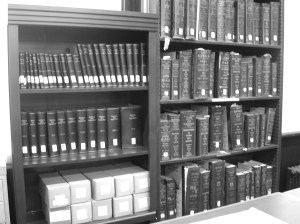
Making an Impact: The Buffalo History Museum Library

Lib 2

Cynthia Van Ness, MLS
Director of Library & Archives

If you’ve taken up genealogy, you know the impact of finally finding a picture of your great-grandfather’s tavern. Or seeing a picture of the long-demolished corner deli where you bought Atomic Fireballs as a kid.

And then there’s the impact when a new fact upends your understanding of what happened back when. Gospel truth does get demoted to urban legend, but first it puts up a fight. One of the just-will-not-die Buffalo urban legends is that in 1901, every house in Buffalo was supposedly photographed for the Pan-American Exposition and we have the pictures. If only it was true!

We do have an estimated 12,000 house pictures dating mostly from 1870-1970, but there was no campaign to photograph the entire city for the Pan-Am. We don’t have pictures of everyone’s house, then or now. There are another estimated 12,000 pictures of schools, factories, churches, hotels, office buildings, grain elevators, and so on. Our pictures are not online, so an in-person visit is needed to see them.

This extensive collection of architectural imagery has another kind of impact: economic.

How so?

Maybe you’ve noticed that Buffalo’s often deteriorated buildings are getting restored, repurposed, and re-occupied at an unprecedented rate. The Lafayette Hotel renovation was just the most celebrated of a long and growing list of rehabs. In Buffalo, existing buildings are attracting more private construction dollars than new-builds. This resurgence has a lot to do with the National Register and New York State’s preservation tax credit program.

In most Buffalo neighborhoods, getting listed on the National Register opens up tax credits for the restoration of old buildings, both residential and commercial. Property owners typically depend on professional architectural historians to write National Register nominations. In turn, professional architectural historians depend on the Library’s collection for historical evidence, visual and otherwise, to make the case for National Register eligibility. We have the region’s largest collection of period photographs, atlases, and architectural drawings.

Investment = jobs, and not just for architectural historians. Bringing back old buildings means hiring architects, engineers, roofers, plumbers, plasterers, electricians, painters, carpenters, decorators, and more. Preservation is good for Buffalo’s economy because when you renovate an existing building, you typically spend about 60% of your budget on labor, which is usually supplied by local talent.  In turn, those paychecks are spent mostly in the local economy on rent, groceries, etc. The remaining 40% goes to materials, which are usually manufactured elsewhere. For a new build, that ratio is reversed. Forty percent of your budget goes to labor and 60% leaves the local economy to buy materials made elsewhere.

We like to think that in our own indirect way, the Library is helping in the revitalization of Buffalo, one building at a time.

To learn more about New York State’s preservation tax credit program, go to: nysparks.com/shpo/tax-credit-programs/
To learn more about the National Register, go to: http://www.nps.gov/nr/faq.htm
To learn more about the economic impact of historic preservation, go to: http://www.achp.gov/economic-general.html

Pan-Am Exposition Map – Then and Now

panammap

Some Pan-Am Planning Fun Facts

  • Eight million Americans celebrated the dawn of a new century by visiting the Pan- American Exposition in 1901
  • The Pan-American Exposition opened its doors on May 1, 1901. Turn-of-the-century Buffalo was prosperous and growing. The exposition’s energy, dazzling presentation, brashness, patriotism, refinement, and hucksterism all captured the spirit of the city.
  • After a series of controversies and delays, the Pan-Am’s Board of Directors selected the
    Rumsey Farm as the site for the exposition. The farm lay between Elmwood and
    Delaware Avenues north of the city’s developed area.
  • During the summer and fall of 1899, hundreds of men working with horse-drawn grading and earth-moving equipment attacked the 350-acre site. Planners laid out a design centered around an inverted “T” to lead visitors toward the Electric Tower, promoted as the height of human achievement.
  • Less than a year later, the site swarmed with the activity of thousands of workers and craftsmen racing to erect the exposition’s 90 major buildings and make them weather- tight before the onset of winter. As the buildings climbed skywards, other groups of workers excavated canals, laid out roads, erected fountains, and installed thousands of trees and shrubs.
  • Buffalo was a growing industrial city with a large immigrant population of Poles, Germans, Italians, recent arrivals from other European countries, and a small community of African Americans. Pan-Am contractors had no trouble hiring large gangs of laborers, carpenters, plasterers, and other skilled craftsmen. In just over 18 months, these workers transformed open farm fields into the “Rainbow City,” an enormous and visually stunning fantasy world.

Stay updated with The Buffalo History Museum blog for more trivia and behind the scenes fun with museum staff!

← Back

Thank you for your response. ✨

15 Artifacts from 15 Decades

1860s: One of our earliest donations, the Ararat Stone ca. 1825, was donated in 1866 by Lewis F. Allen.

1870s: One of our library’s most frequently referenced artifacts is the Hopkins Atlas of 1872. While we have many maps and other atlases, it is the first to illustrate footprints of every building in Buffalo and list the property owner’s name.

1880s: Buffalo’s Julius E. Francis was a true Abraham Lincoln worshiper. He amassed a sizable collection of Lincoln and Civil War artifacts. In the 1880s, Francis first installed his collection at the Young Men’s Association Building.

1890s: In 1898, we acquired the Red Jacket Medal from Minnie Van Renssealer for $100.

1900s: District Attorney Penney turned over the Czolgosz relics to the Society in 1902.

1910s: 2 brass tablets, one in memory of Millard Fillmore and one in memory of Grover Cleveland, were unveiled at the museum to celebrate our 50th anniversary in 1912.

1920s: The Apostolic clock was donated in 1923 by creator Mr. Myles Hughes.

1930s: In 1937, George W. Benson officially donated his extensive glass and ceramics collections, including examples of valuable 19th and early 20th century pieces.

1940s: In 1948, we purchased the Trial of Red Jacket after being on loan to the museum since 1904.

The Centaur statue in front of the museum was donated in 1953.

The Centaur statue in front of the museum was donated in 1953.

1950s: During the 1950s, the Collections Department began using the compound numbering system to accession artifacts. This system is the most prevalent in museums throughout the country and is still in use today.

1960s: In 1965, we re-inventoried and cataloged a donation from former First Lady and Buffalo native Francis Folsom. Dating from her school days, the interesting array of material includes student notebooks, compositions, and tests.

1970s: In the 1970s, we obtained a grant to photograph all of the artifacts in its collections; The Wettlaufer Glass Collection  was aquired in 1972.

1980s: Julia Boyer Reinstein donated her impressive collection of over 80 historic quilts and coverlets.

1990s: In 1999, William G. Gisel Sr. donated a collection of artifacts from Bell Aerospace, including a Bell Agena model no. 8096 rocket engine.

2000s: Philanthropist Charles Rand Penney lived the life of a consummate collector, meticulously assembling more than 100,000 objects. Upon his death, we acquired his Larkin Company collection. Comprised of nearly 700 artifacts, his collection of Larkin premiums particularly filled a gap in our collection.