Collections

Albert H. Chestnut Diaries

French Toast – Dip stale slices in batter of thick milk (1/2 small cup/eggs),

sugar, salt, eggs, vanilla & fry with little more cream then pancakes – can deep fry

Does the recipe trigger a happy memory of cooking with a family member? Or a morning breakfast with a good friend? To Albert Chestnut a recipe was a motivator to help him survive. Albert was a prisoner of war. The Japanese held him captive in the Philippines and Japan for a total of three years and five months during World War II. While captive, he spent much of his time reading, playing cards and writing in his diaries about the poor and inadequate food he was served. At his lightest, Albert weighed less than 100 pounds, was malnourished and tried to obtain vitamins from Japanese doctors. Many of the final pages in Albert’s first diary are devoted to recipes and planning out weeks’ worth of meals for when he hopes to return home; return home to Buffalo.

For the past few months, I have been fortunate enough to spend time transcribing Albert’s diaries. Albert wrote in unusually tiny pencil handwriting, 1/16” at the most, which is why I have been devoting my time and eyes to transcribing his personal piece of history. Because of the pencil writing, there are often words or sections of pages that have become smudged or blurred making it difficult to read portions of the passages.

Albert Chestnut

Albert Chestnut, photo from the collection of The Buffalo History Museum

Albert Chesnut’s first diary begins around April 9th, 1942, the day the United States surrendered at Bataan and Americans and Filipinos were consequently taken captive by the Japanese. April 9th is also the first day of the Bataan Death March; a march that led Albert and the other prisoners up the Bataan peninsula stopping at Marveles, Cabatuan, St. Fernando and finally, ending at Camp O’Donnell, an eighty mile march, which was completed in only eleven days. After nearly seven months of being held at Camp O’Donnell, Albert’s hope of a quick rescue was beginning to fade; “November 1 – Must admit that am quite disappointed for honestly hope help would come by now.” Three days later Albert was sent by train back down to Manila, marched through the business district and held on a dock in the bay for four days. Over a thousand men were then packed below the deck of Nagato Maru, known as a Japanese Hell Ship, and sent to Japan. “November 7 – Last night a real terror – Left Manila about noon as part of big convoy – Really sort of glad to leave Philippines but even ocean breeze cannot help heat and stench of hold where have to eat too – Toilet facilities hopelessly inadequate – Two meals a day – Packed 75% of men below for night as heat terrific – Had hatch covered for time to keep out rain.”

Once in Japan, Albert was sent to Osaka and, on January 16, 1943, he began his stay at a camp know as Zentsuji. While there, Albert faced many of the same conditions as Camp O’Donnell; starvation, poor sanitary conditions, and a constant risk of life threatening diseases. Keeping his spirits up Albert spent much of his time reading censored Japanese newspapers, reading circulating books (“Franklin” by Bernard Fay, “The Well Tempered Listener” by Deems Taylor, “Hunchback of Notre Dame” by Victor Hugo), playing card games, attending prisoner run classes such as Spanish, Trigonometry and Bookkeeping, and going to lectures at night also given by other prisoners.

I am beginning transcription of the second diary and have reached December of 1944, but still have months to get through. As of December 1944, Albert is still being held at Zentsuji, but as I read, I routinely find heartbreaking entries such as these:

“March 17 1943 – Another glorious spring day for St. Patrick’s Day – Badly miss the little Irish box sis always sent for the season.”
“April 26 1943 – …Certainly miss Easter eggs and basket of other years which gave me so much pleasure for days afterwards.”
“June 6 1943– Today is sis’ birthday and feel sorry can’t help her celebrate.”

Pages from Albert Chestnut's diary, from the collection of The Buffalo History Museum.

Pages from Albert Chestnut’s diary, from the collection of The Buffalo History Museum.

Reading and transcribing these diaries have taken me to another place in a different time and have reminded me to be grateful for everything I have. For curious readers, I skipped ahead to Albert’s final entry on October 22 1945; he writes “This was the day of days, the culmination of over four years of hoping, waiting and praying – At just past 12:30AM train left Buffalo and mother and sis waiting with box of cookies and other stuff.”

Albert Chestnut donated his diaries, the photograph in this post, his Army commission and other family papers in 1999 (Mss. A99-10). Due to the fragility of the diary bindings and the possible handling smudges, the physical use of the diaries are restricted to serious researchers with a valid ID from an institution of higher learning and are engaged in a PhD dissertation. I invite you to come in to the Research Library, take advantage of the transcription and take a transformational journey with Albert Chestnut.

Amy Miller
Assistant Librarian
Signs from Different Times

Working in the museum’s Collections Department has given me the chance to encounter some very interesting artifacts. The same can be said for my work as the Archivist for the Sisters of St. Joseph of Buffalo. I never thought to contemplate what kinds of similar things exist in both places until the idea was presented to me.  In looking back at everything I have worked on over the years, I realized that  one type of object I had come across quite a few times were signs. It’s a funny thing to think about what a sign can really mean to a place, people, and/ or time in history. When I see a sign on a building, or on the side of a road, I don’t really think deeply about its significance. But when a sign is viewed outside of its original location, or out of context, it almost forces you to think about where it came from and its significance. Some of my most interesting research has been done because of signs.

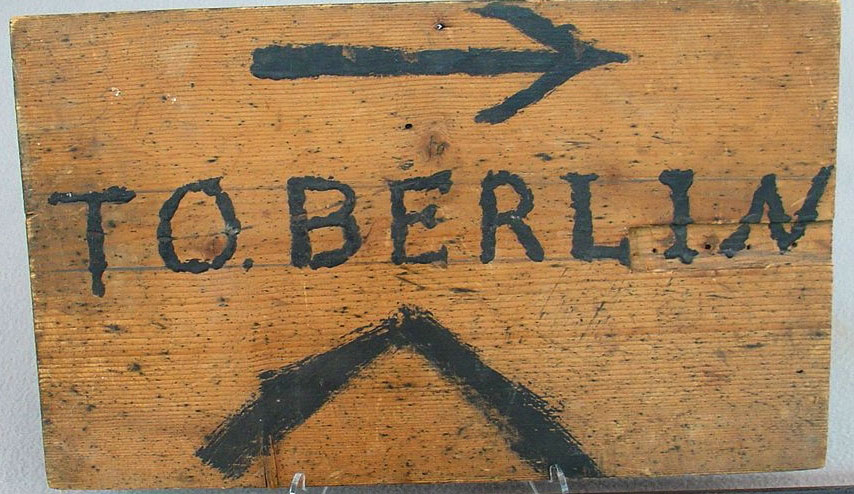
One of the first signs I worked on at the museum was one made by a member of the American Expeditionary Forces in WWI. For history buffs like myself, researching information about important historical periods, like WWI, is usually something to look forward to because more times than not you come out knowing so much more than you knew before you started. WWI sign

For example, “TO BERLIN”:  I knew before starting my research that it was originally hung in a town in France called Thiaucourt.  What I discovered was that the town was involved in a major battle of the war, the St. Mihiel Offensive, which was led by General John “Black Jack” Pershing in September 1918. This action during the war was particularly significant because it was the first large-scale offensive action that was taken by American forces independent of the Allies. It never ceases to amaze me when I see objects like this sign which have withstood the destructive violence of war and yet find their way to places thousands of miles away. I only wish that we knew more about the man (or men) who made that journey happen.

In a city like Buffalo, there is a lot of history to look back on and reminisce about. There have been a lot of events, neighborhoods, people, and buildings that have made the city what it is. Once in a while those things come back into the spotlight and being able to look at artifacts from the past makes for an interesting comparison to the present. One area of the city that has been in the headlines for many years is the Webster Block.
???????????????????????????????
 It was a timely thing, then, when I came across two street markers from the corner of Main and Perry Streets ???????????????????????????????during the time the sale to the Sabres was happening. These marble street signs were actually incorporated into the exterior of a building that sat at that corner in 1838. They were chiseled from the sides of the building at an unknown time and eventually donated to the History Museum in 1969. Not having known much about the Webster Block before working on these signs, I was unaware that part of it was located at this intersection and in doing my research, I was even more surprised to find that it had been built up all the way back in 1835 by a prominent figure in Buffalo history, Benjamin Rathbun. Just because of these two signs, I learned some very interesting information about the city I’ve lived in my whole life that I had never even thought to ponder.

It’s amazing what a sign can show you!

Sabine Fisher
Collections Assistant

Me and Mabel Barnes

– Kindred WNY spirits in history?

Since I began working at The Buffalo History Museum last July, I’ve thought more about personal histories and the artifacts that we leave behind as individuals.

During my first month, Melissa, The Buffalo History Museum Executive Director,  referred to the diary of Mabel Barnes numerous times. Mabel’s diary is one of the museum’s most detailed personal journals in its collection from the  1901 Pan American Exposition. Our conversations about Mabel’s diary and how valuable it is to researchers today – 113 years after the Pan Am – inspired me to dive into my personal journals, which had not been cracked open since 2004.

Journals by Kim

Adamant about  journal writing…  

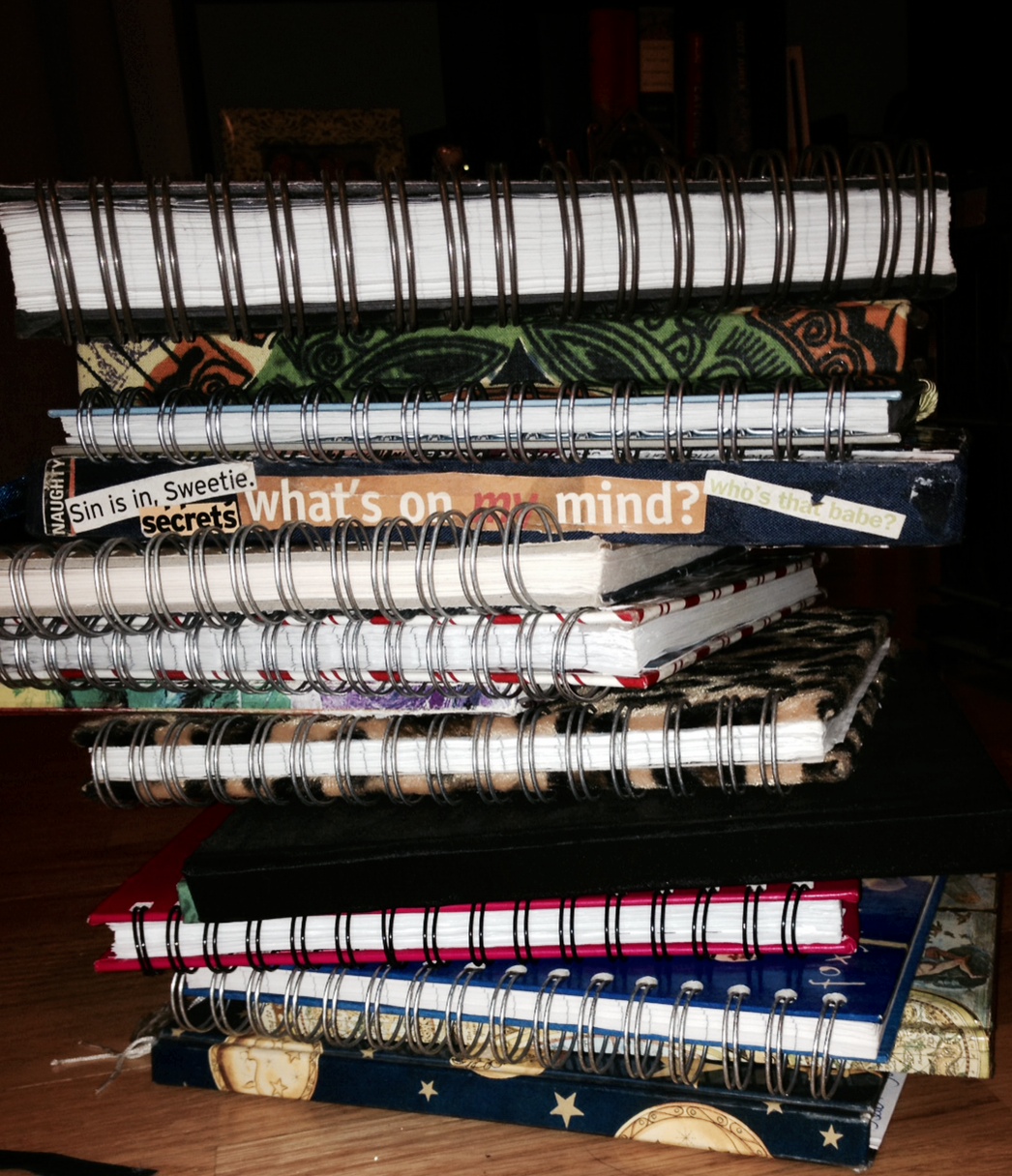
From the ages of 12 – 19, I was adamant about journal writing. I have a stack of bright spiral bound notebooks, covers ranging from leopard fur, polka dots and hot pink, documenting my adolescent years. It’s pretty incredible to look back ten, fifteen years ago and read, in my own handwriting, about what ailed me.

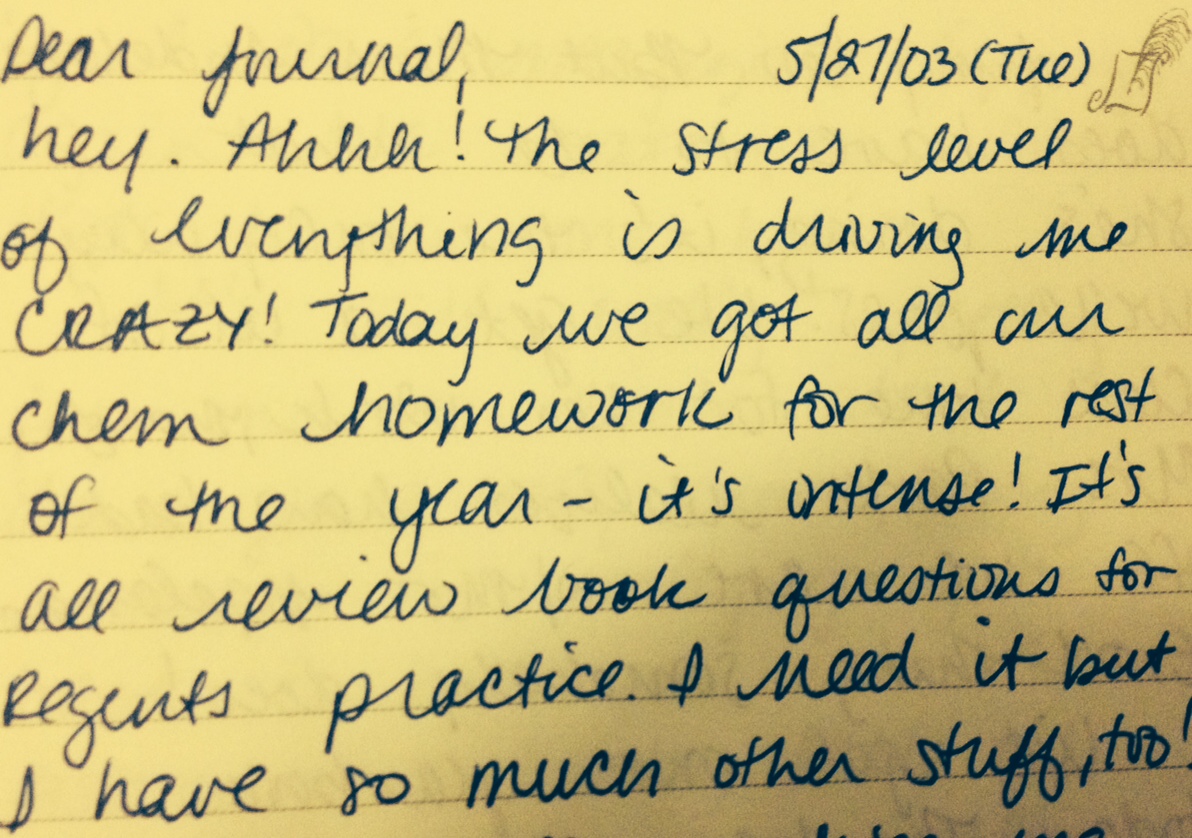
Honestly, I forgot how hard high school was. I forgot how stressed I became over school, sports, a part time job and friends. The excerpt photographed is from May, 2003. As juniors, we had to take five NYS Regents (English, American History, Chemistry, Math B and Foreign Language) exams within the same week. It was grueling. Studying for and passing these exams was all I wrote about for a month.

A  page from Kim's diary

An intense page!

There was a break in the study pattern when my best friend and I bought copies of “Harry Potter and the Order of the Phoenix” – we even drove ourselves in Shannon’s clunker and ate at Mighty Taco – at MIDNIGHT! Very cool at 17 years old…

Twenty-five pages of suspense later, I wrote about passing all five Regents exams, though not all with grades mom wanted to plaster on the fridge.

I took a hiatus from journal writing from college through last year. My exposure to personal histories here at the museum has made me more cognizant of my personal legacy. I want my grandchildren to read what I went through – to know that I, too, worried about passing tests, getting my driver’s license, and finding a prom date (not an easy feat at an all girl’s high school). I hope that my future family will be able to relate and find joy from my teenage years.

My New Years’ resolution was to start journaling again this year. Two and a half months in, I’m holding strong.

Kimberly Luangpakdy
Director of Resource Development 

Mabel Barnes page

A page from Mabel Barnes journal.

Mabel Barnes, daughter of Joshua Barnes, a confectioner, was born in 1877 and was part of the Old Central High School graduating class of 1894.  She began her teaching career with the Buffalo Public Schools at School 23 on Delavan Street in November 1895.  She attended the 1901 Pan Am Exhibition 34 times. 

Greetings!

Today Jen and I dialed up our go-to-guy-for-all-things-museum-cool, Brian McAlonie, at Thinking Outside the Square

Brian running a workshop under the portico.

Brian running a workshop under the portico.

We wanted to pick his brain about our new blog, cuz if ever there was a great go-to place for expert feedback, it’s at TOTS.

jenworking2

Jen working hard on our quarterly newsletter.

The good news: Brian likes The Buffalo History Museum’s Blog! 

Jen LaBella, TBHM Marketing Associate and Graphic Artist, deserves big kudos for setting it up. Yours truly souped up the “Latest News” page on our website by linking the blog button. BlogButton

We are now ready to share to the universe and we’re psyched about our new (to us) frontier!  We hope the content ahead serves an audience with extra special museum and history news: from the ordinary to the extraordinary, we’re here to share.   

Cmc and Walt

Walt & me on the portico.

Just in, as I was writing this:  Walt Mayer, Director of Museum Collections, called to tell me about a great idea for sharing Victorian love sentiments from the collection every Friday in February to celebrate Valentine’s Day!  You’ll be able to find that on our Facebook page so check back in to see some historic images of romance.

 Gotta run, lots to do… 

 – Connie Caldwell, Director of Communications & Community Engagement

15 Artifacts from 15 Decades

1860s: One of our earliest donations, the Ararat Stone ca. 1825, was donated in 1866 by Lewis F. Allen.

1870s: One of our library’s most frequently referenced artifacts is the Hopkins Atlas of 1872. While we have many maps and other atlases, it is the first to illustrate footprints of every building in Buffalo and list the property owner’s name.

1880s: Buffalo’s Julius E. Francis was a true Abraham Lincoln worshiper. He amassed a sizable collection of Lincoln and Civil War artifacts. In the 1880s, Francis first installed his collection at the Young Men’s Association Building.

1890s: In 1898, we acquired the Red Jacket Medal from Minnie Van Renssealer for $100.

1900s: District Attorney Penney turned over the Czolgosz relics to the Society in 1902.

1910s: 2 brass tablets, one in memory of Millard Fillmore and one in memory of Grover Cleveland, were unveiled at the museum to celebrate our 50th anniversary in 1912.

1920s: The Apostolic clock was donated in 1923 by creator Mr. Myles Hughes.

1930s: In 1937, George W. Benson officially donated his extensive glass and ceramics collections, including examples of valuable 19th and early 20th century pieces.

1940s: In 1948, we purchased the Trial of Red Jacket after being on loan to the museum since 1904.

The Centaur statue in front of the museum was donated in 1953.

The Centaur statue in front of the museum was donated in 1953.

1950s: During the 1950s, the Collections Department began using the compound numbering system to accession artifacts. This system is the most prevalent in museums throughout the country and is still in use today.

1960s: In 1965, we re-inventoried and cataloged a donation from former First Lady and Buffalo native Francis Folsom. Dating from her school days, the interesting array of material includes student notebooks, compositions, and tests.

1970s: In the 1970s, we obtained a grant to photograph all of the artifacts in its collections; The Wettlaufer Glass Collection  was aquired in 1972.

1980s: Julia Boyer Reinstein donated her impressive collection of over 80 historic quilts and coverlets.

1990s: In 1999, William G. Gisel Sr. donated a collection of artifacts from Bell Aerospace, including a Bell Agena model no. 8096 rocket engine.

2000s: Philanthropist Charles Rand Penney lived the life of a consummate collector, meticulously assembling more than 100,000 objects. Upon his death, we acquired his Larkin Company collection. Comprised of nearly 700 artifacts, his collection of Larkin premiums particularly filled a gap in our collection.