Month: January 2017

On This Day: January 24, 1935

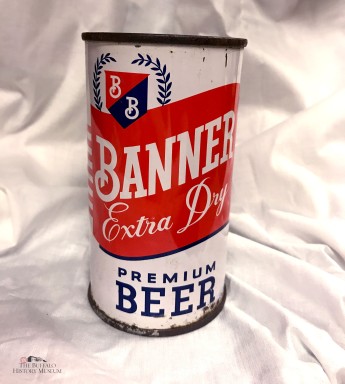
bannercan_front

Can of Banner Extra Dry Premium Beer, brewed, canned and packed by George F. Stein Brewery Inc., Buffalo, NY

On this day (OTD) in 1935, the first can of beer was sold in Richmond, Virginia by the Gottfried Krueger Brewing Company; 91% of the consumers approved of the canned beer and as they say, the rest is history.  Historically, Buffalo has always been an alcoholic-beverage-loving city – just take a look at the Google maps Buffalo Drinking Map from 1828 to present day that Amy Miller, from our Library, created.   We have numerous beer bottles in our Collection that were used by many of the local brewers throughout Buffalo’s history, but in celebration of the ‘beer can’ theme today, we scanned through our database, Past Perfect, to see what we could find.

Donated in 2011 by Mr. Phillip DiFrancisco, this can of Banner Extra Dry Premium Beer was brewed, canned and packed by George F. Stein Brewery Inc..  The owner of the brewery, Mr. George F. Stein, was born in Germany in 1865, learning how to brew in Bavarian breweries until 1885, when we moved to Buffalo, N.Y. as an employee at the Lang brewery.  He would go on to work for the International brewery and the Clinton Star brewery before starting the Germania Brewing Company (located at Broadway and Bailey avenue) from 1892-1909 with his father-in-law, Conrad Hammer.
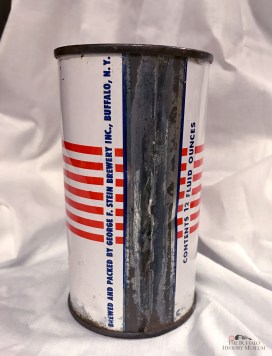
bannercan_backFrom 1909 until 1918, Stein operated Stein’s Ale Brewery in Medina but returned to Buffalo as the brewmaster of the Binz brewery at 797-807 Broadway Ave.  In 1920, Prohibition closed all breweries but Stein purchased the Broadway Ave. building in 1928 and began manufacturing liquid malt, concentrated malt and syrups to sell to bakeries as the Broadway Blending Company.  When beer was legalized in 1933, Stein began to brew beer again at the George F. Stein Brewery Inc. until his death in 1938.

After 25 years of successful business, the George F. Stein Brewery Inc. was purchased by the Leisy Brewing Company (Cleveland, OH) and closed shortly thereafter.
What is WorldCat and Why Do We Love It?

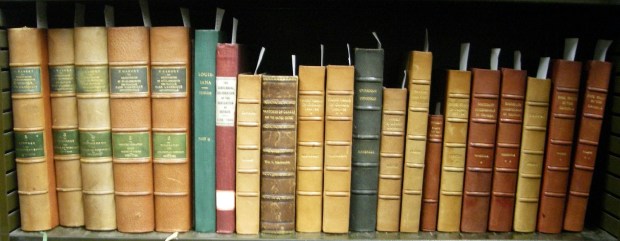
portershelf-small

“The majority of information lies outside the Internet.”
– Jens Redmer, Director of Google Book Search, quoted at Slippery Brick, January 2007

“What’s on the web is extremely ephemeral. Very little of it was written before 1995.”
– Brewster Kahle, creator of the Internet Wayback   Machine, quoted in Newsweek, March 29, 2004 p. 58.

Anyone with an interest in the past soon realizes that Google does not represent the sum total of all recorded human knowledge.  The Buffalo History Museum has been collecting paper-based history for 150 years now, amassing library collections that include 23,000 books, 2,000 manuscript collections, 200,000 pictures & photographs, 7,000 postcards, 7,000 microfilms, 10,000 maps, plans, drawings, and posters, hundreds of reel-to-reel audio recordings, hundreds of periodicals, and uncounted thousands of pamphlets, brochures, newspaper clippings, and other paper-based ephemera.

So, considering that people have been storing information on paper for about 1000 years and the internet is only about 20 years old, how do you figure out what is out there for research purposes if it isn’t digitized and optimized for search engines?

Enter WorldCat.org, which you can think of as Google for the offline world.  It is one free giant online card CATalog for the WORLD’s libraries.  The Research Library has been computerizing its bibliographic records for almost 30 years and has contributed over 25,000 of them to WorldCat, which now boasts one billion records of items found in the libraries all over the planet. Those same 25,000 bibliographic records are also searchable in our in-house catalog, FRANK (Find Resources And New Knowledge).

If you look up Lauren Belfer in FRANK, you discover that the Research Library owns her popular Buffalo novel, City of Light.  If you look her up as an author in WorldCat, you discover that there are 21 entries for her, including Swedish, Italian, and French translations of City of Light.  Click on any one title to see which libraries own copies.

When a book actually is online in full text, catalogers can build a link into their bibliographic records, enabling you to read it at your computer.  But only a tiny percentage of books, newspapers, etc. have been scanned.  Your WorldCat search results will usually show you records of undigitized books, maps, newspapers, periodicals, recordings, letters, and diaries that reside in library collections and must be viewed in person.  In other words, the past is not online.

In the Library, we use WorldCat to figure out who owns something when we do not.  WorldCat showed us that the internal business records of the Bethlehem Steel Company (over 200 linear feet!), including the Lackawanna plant, are held by the Hagley Museum in Wilmington, Delaware.

Your mission, should you choose to accept it, is to look in WorldCat for an early short story by Lauren Belfer.  Once you find it, you will discover that it is set in Buffalo and is readable online in full text.  Happy hunting, everyone!

Cynthia Van Ness, MLS
Director of Library & Archives

*This article was featured in the Winter 2012-2013 issue of “The Album”