buffalo history

Favorite Library Acquisitions

During my tenure here at The Buffalo History Museum, I have had many interesting items and collections come across my desk. The vast majority are from generous donations and a select few are ones my boss has found. I’ve decided to pick out a few of my favorites to share with you.
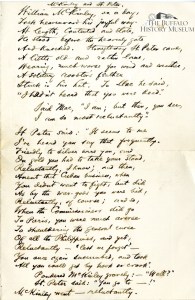
McKinley Poem1. McKinley Poem, 1899. Call number: Mss. A2013-33

This poem is written on the back of a note from Augustus Strong of Rochester to Wilson Bissell of Buffalo; however, the author of the poem is unknown. What is so intriguing about the poem is the prediction of President McKinley facing St. Peter and answering for his polices while holding office. The poem was written in 1899 and sent to a resident of Buffalo. As you all know, President McKinley was assassinated two years later in Buffalo.


2. Meldrum’s special Pinochle playing cards. Call number: GV 1235 .M4 1915   HA Meldrum Co Pinochle Cards

Library catalogers typically don’t encounter 3D objects; those are more frequently found in museum artifact collections. However, we received a donation of a deck of Pinochle playing cards from H.A. Meldrum and wanted to include these in the library collection due to the image of the department store on the cards. This was a unique challenge to accurately describe the cards, a 3D object, within the confines of a library catalog that typically deals with paper.


3. Exit 51W / by Kasia Keeley. Call number: Rare N 6498 .P37 B8 2012

This was another fascinating discovery by my boss and would more accurately be described as artwork than a book, as it contains no linguistic content. It proved to be another unique challenge for me as a cataloger. The artist created a serigraphy and cut paper book of scenes along I-90W from the East, Rt. 33 at Exit51W and Rt. 198. The book has a single piece of grey card stock holding it together that once opened, unfolds like an accordion. Over top of the card stock, the artist has cut paper scenes. They include the Statue of David, the Richardson Complex, the Buffalo History Museum, Niagara Street, the Electric Tower and the Liberty building to name a few. If you’re interested in seeing it, stop by the library or check out the artist website: http://www.kasiakeeley.com/Kasia_Keeley_Artwork/Exit_51W.html


4. Edward Cook Freedom Papers. Call number: Mss. A2013-110 A2013-110 Edward Cook Obit
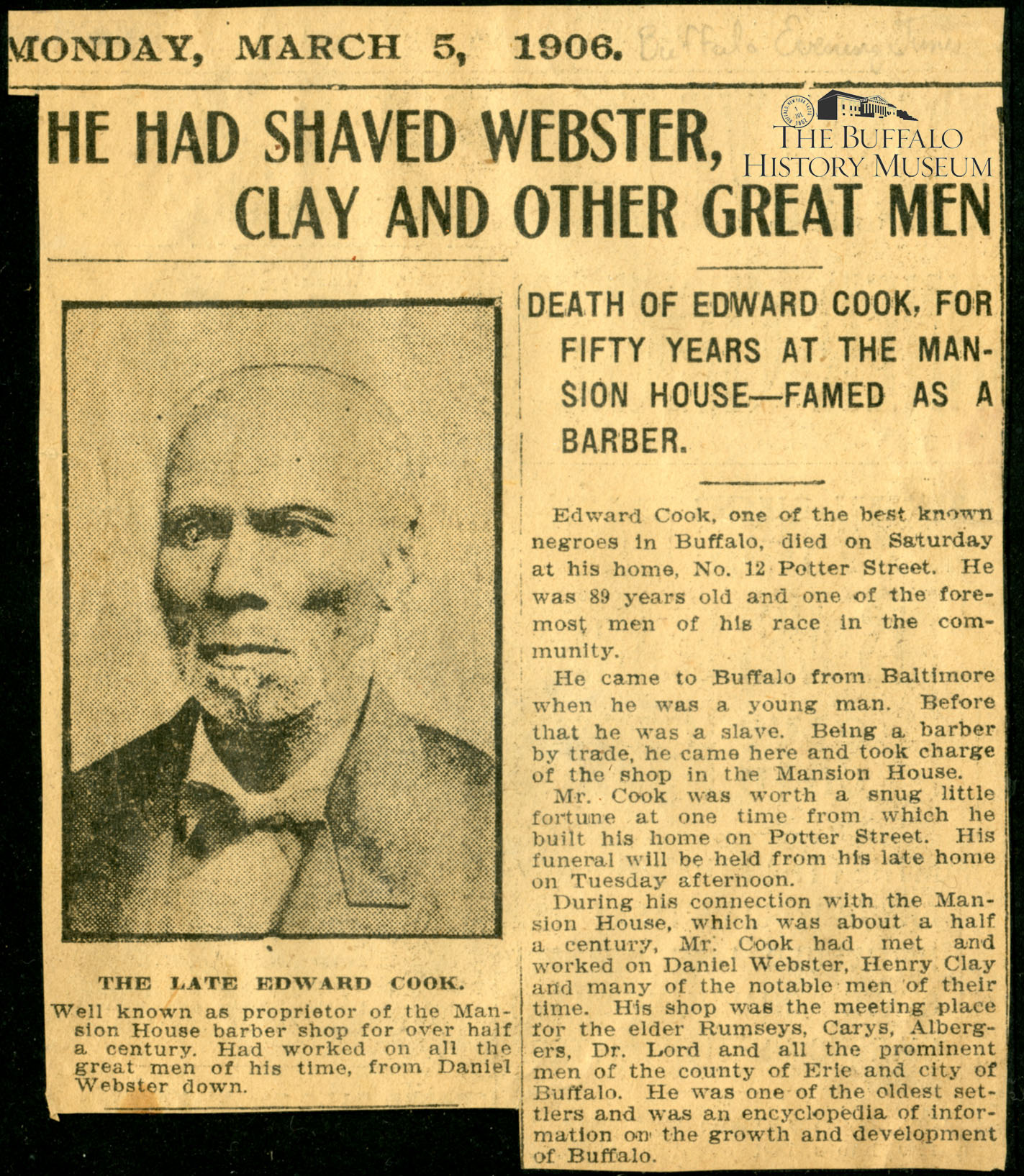
Just like the many archives of the world, we too make our own discoveries. While only ‘lost’ for a short time, the needs of this collection were finally able to be met 10 years after acquiring it. The collection was donated in 2003 by Dr. Bruce Lee, a descendant of Cook. Edward was the son of Henry Cook, who came to Maryland in slavery from Africa. Henry escaped slavery and joined the Mohawk Indian tribe. He met and married Patty, an Indian woman, and together had Edward, making Edward a free man. Edward moved to Buffalo as a young man, where he made a living being a barber at the Mansion House. The collection includes a photograph of Edward, Baltimore County freedom paper certifying he was born free, baptism certificate for Edward, a permission note to travel at night and his obituary.

Queerie Queers
5. Queerie queers with hands, wings and claws with illustrations by Palmer Cox.
    Call number: Rare PR 9199.2 .C69 Q84

This children’s book, illustrated by Palmer Cox, was published by John D. Larkin out of 663 Seneca Street. The book features many short stories, magic tricks to do at home and less than common nursery rhymes. For example, I grew up on the simple version of “Jack and Jill went up the hill to fetch a pail of water.” However, the version John D. Larkin helped to publish had a much longer introduction to Jack & Jill. “For an idle lad, as he was, Jack had no traits, after all, that were very bad. He was simply Jack with the coat on his back patched up in all color from gray to black. Both feet were bare; and I do declare that he never washed his face; and his hair was the color of straw.” Thankfully, his soap business was more successful than his publishing.

Amy Miller
Assistant Librarian & Archivist

Secrets from the stacks: Erie County Penitentiary Prisoner Identification Cards

The “Secrets from the Stacks” is a program that is offered only a few times a year to spotlight items the Research Library does not typically get to show off. The program being held on June 6, 2015 will feature the Erie County Penitentiary prisoner identification cards (Mss. B85-6). The collection dates from 1896 to 1914, with the bulk of the photographs being from 1899 to 1905. This collection was donated to the Research Library by the Erie County Correctional Facility (Wende) in 1986 and just recently has been arranged, indexed and cataloged, making it accessible to interested researchers with a Scholar Pass.

Antwater Back WatermarkThe identification cards used by the Erie County Penitentiary are the precursor to modern day finger printing. The cards mimic the Bertillon system in order to identify repeat offenders by their physical features and dimensions, such as their head length, length of middle finger and the length of their foot. The cards also contain the offender’s name, aliases, age, nativity, occupation, charges and sentencing information. These cards were then arranged by a unique system and referenced upon their re-arrest. The Research Library greatly appreciated the donation due to the collections valuable genealogical, sociological, criminology and anthropological research potential.

The program will feature many of the identification cards for the attendees to view, along with photographs of the Erie County Penitentiary to help place the collection within context and other true crime resources. The program will run from 10 am to 12 pm on June 6, 2015. The completed index is available online, by going to http://tinyurl.com/TBHM-prisoners.

Amy Miller
Assistant Librarian & Archivist

Spotlight Artifact: Pacemaker

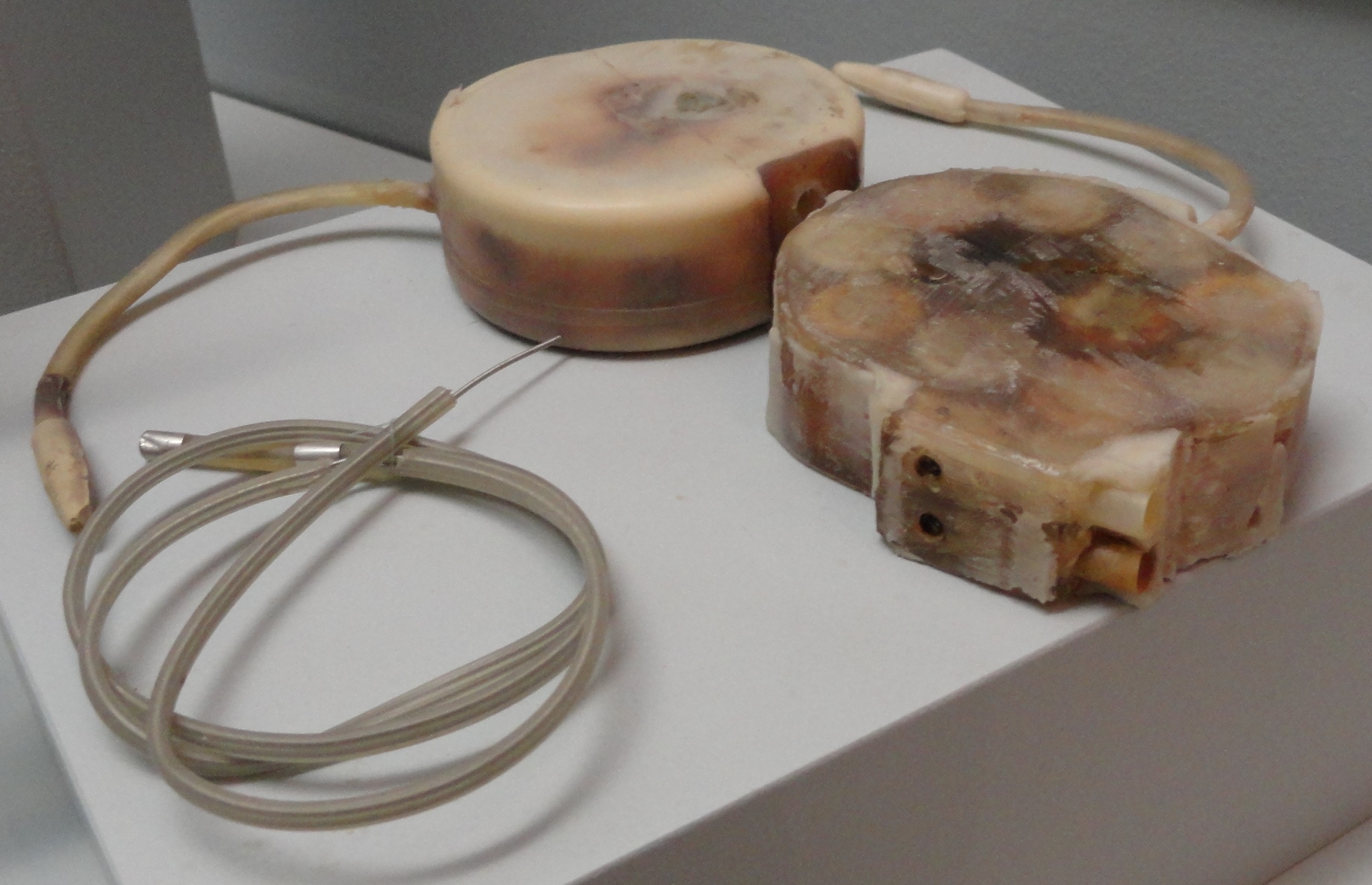
From the TBHM Collection Medtronic Minneapolis, MN 1965

From the TBHM Collection
Medtronic
Minneapolis, MN
1965

In 1958, Dr. Wilson Greatbatch of Clarence, NY invented and patented the lifesaving cardiac pacemaker. Dr. Greatbatch worked alongside Dr. William M. Chardack and Dr. Andrew A. Gage to create the device and it was first used in humans at Millard Fillmore Hospital in 1960. The variable rate/variable output artificial implantable cardiac pacemaker and the fixed rate/fixed output artificial implantable cardiac pacemaker, which are shown in the photograph above, are on permanent display in the Bflo. Made! Exhibit. These two medical marvels are perfect examples of the ingenuity and inventiveness that Western New York has to offer.

Dr. Greatbatch founded Wilson Greatbatch Ltd. in 1970 to develop long-lived primary batteries to fuel pacemakers. He created the lithium iodide battery system to replace the mercury batteries that powered the early models that are on display in the museum. To this day, both the pacemakers and the special batteries that meet the particular needs of the pacemaker’s pulse generators are made by Wilson Greatbatch, Ltd. in Clarence. Dr. Greatbatch’s exceptional inventions maintain a profound, global impact in our lives.

– Rebecca Justinger, Registrar

*This article was featured in the Winter 2013 issue of “The Album”

Buffalo’s Julius Francis and Mr. Lincoln

JuliusFrancisJulius E. Francis came to Buffalo in 1835 from Connecticut and ran a successful drug store business for nearly 35 years, mostly at 268 Main Street. The photo above is of his store at 16 South Division St. Beginning in 1865, with the assassination of President Abraham Lincoln, Francis became absorbed in preserving and promoting the martyred President’s memory. He collected much Civil War and Lincoln memorabilia, but determined that there must be a national observance of Lincoln’s birthday, February 12. A bachelor, he declared that this cause was “my wife and my life.” At his own expense, Francis held the first of seven annual observances of Lincoln’s birthday. Each year until his death in 1881, he rented a hall, arranged the speakers, poets, music, essayists, and invited the public to attend free of charge and honor Abraham Lincoln.

PAB_11.14.2007 Lincoln-His two attempts to persuade Congress to establish a national Lincoln’s Birthday holiday failed and he died in 1881, having founded the Buffalo Lincoln’s Birthday Association which continued the work. In his will, he made the Association heirs to his house and lot at 145 East Eagle Street, and six $1,000 bonds. In 1901, the Association contracted with New York sculptor, Charles H. Niehaus, to create a statue of Lincoln that would grace the new Buffalo Historical Society in September, 1902. Their Francis legacy had grown to $10,000 ($221,556 in 2005 dollars), of which they spent $6,000 for the 1,200 pound bronze statue. At least one copy of this statue exists, in a park in Kenosha, Wisconsin. The chair is a copy of Lincoln’s “chair of state,” stored at the Smithsonian.

The original location of the statue was in a portion of the new Buffalo History Museum building named, “The Lincoln Room.” That room also contained the Francis Lincoln memorabilia collection. In the early 1930’s, the statue was moved outdoors in front of the South Portico of The Buffalo History Museum, where is remains today.

Lincoln’s Birthday was never designated as a national holiday (unlike George Washington’s), but was approved as a legal holiday in a number of states. Today, most people assume incorrectly that President’s Day nationally honors both Washington and Lincoln.

2006 is the 132nd year during which observances have been made in Buffalo for Lincoln’s birthday. The ceremonies are carried on in Julius Francis’ memory, also, for having the passion and the vision to celebrate one of the greatest American Presidents.

Article written by Susan Eck and featured in “Western New York Heritage Magazine”

Join us this Sunday, February 15th for President Lincoln’s Birthday Celebration!

Howard Beach Collection: Student Notes

Our project to research a portion of the Howard Beach is underway. My group and I have selected a number of glass slides. Some of us chose a theme, like military uniforms or wedding day portraits, or whatever they found interesting. My selections range from a high school hockey team portrait, to a gentleman outfitted in an elaborate tux, to a rather humorous baby. I look forward to researching these individuals and learning more about them and their lives.

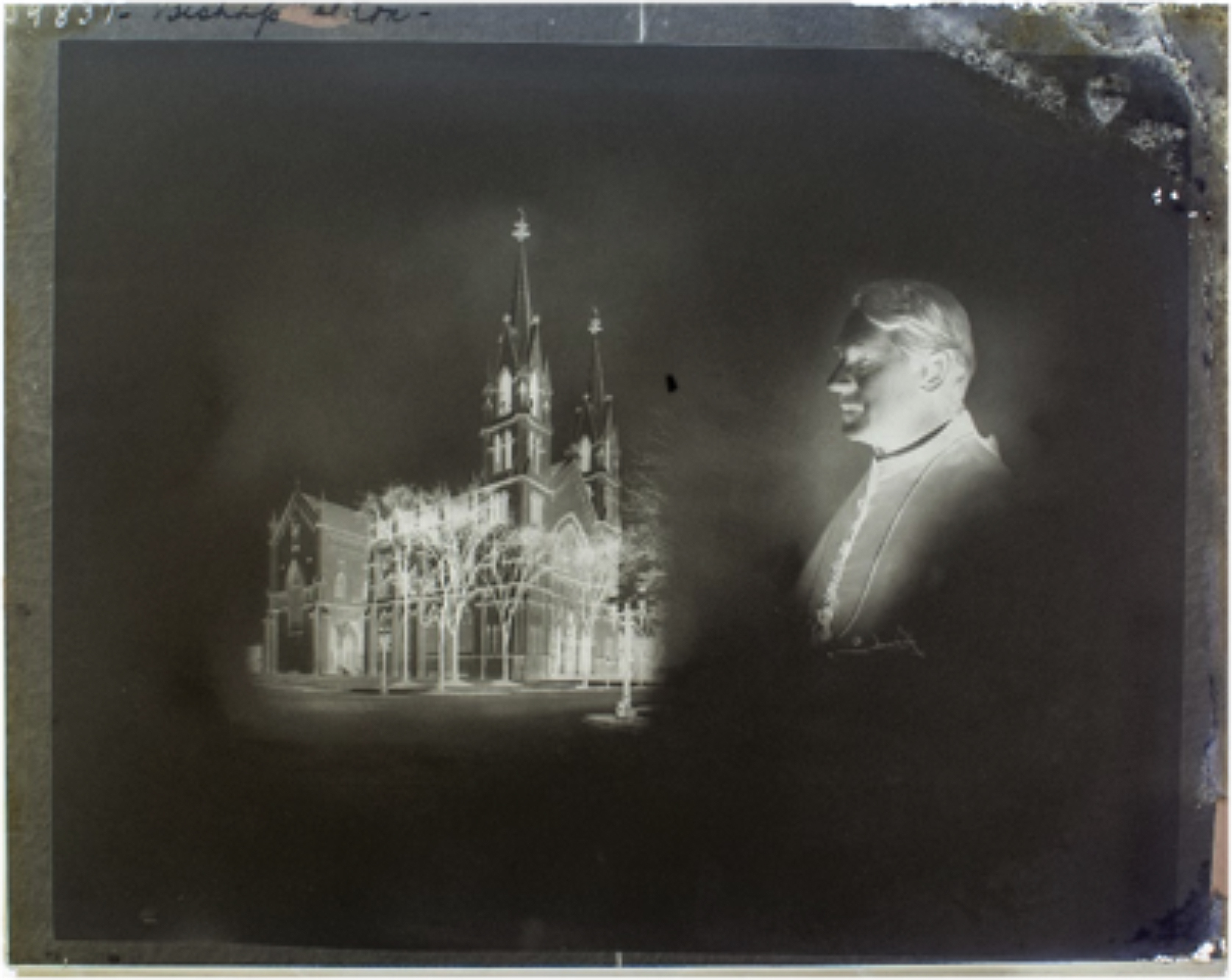
Figure 1: 39837 Bishop Colton Negative

Figure 1: 39837 Bishop Colton Negative

Since our slides have been selected, we have photographed them so that they can be preserved digitally. Once these were digitized we were able to invert them, bringing the image to life. I must admit the first time I saw one of my slides inverted I shouted in excitement; the image was so much better than I had imagined. Here I have a sample of a slide of one Bishop Colton and what I assume was his cathedral. I have more research ahead of me to know for sure.

Figure 2: 39837 Bishop Colton Positive

Figure 2: 39837 Bishop Colton Positive

Helping in part of this research is the card catalog that was also found along with the slides. Having an archives in original order like this is incredibly important, this gives us a look into the mind of the archives creator, in this case, Beach himself. It shows us how he thought, how he worked, what a typical business day would be like for him. Once we located the associated catalog card for each of our slides, we digitized these as well, as seen in Figure 3 here. Another aspect I particularly like about the catalog card is that they were all hand written by Beach himself, this is just another of the rich connections to the past that this project has to offer.

Figure 3: 39837 Bishop Colton Catalog Card

Figure 3: 39837 Bishop Colton Catalog Card

From here I have hours of research to look forward to. I hope to uncover everything I can about the people in these images. I can only imagine the histories, mysteries, war stories, scandals, or family legends I may discover.

– Megan Barr
Museum Studies student at Buffalo State

Discovering the Howard D. Beach Collection: A Journey Into History (Part 2)

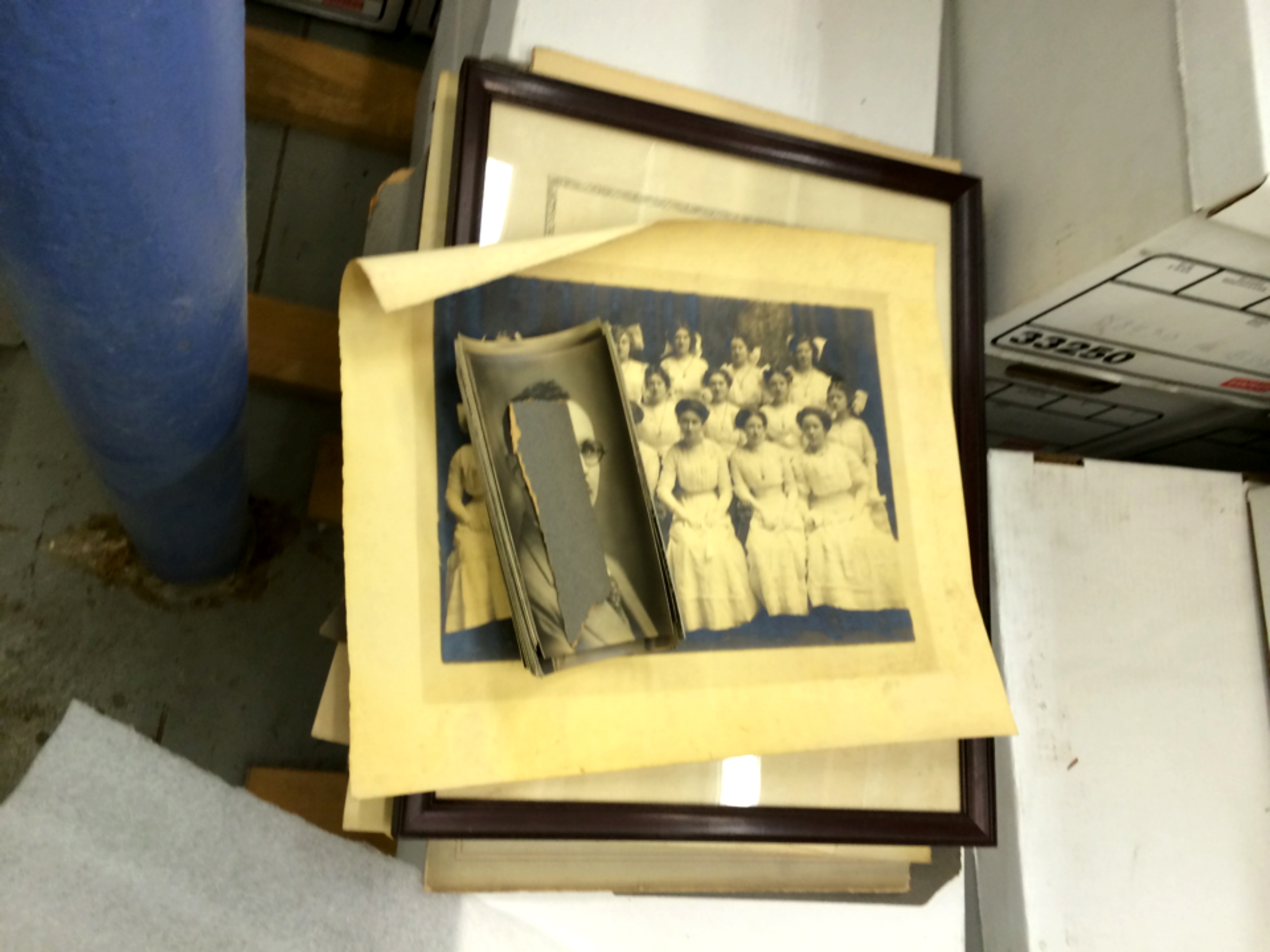
beach14Today, I went to class with more excitement and anticipation about what I might find in the next box of negatives. I chose another banker box at random marked 44400-44800. I opened the lid to find the negative boxes extremely decayed.

Figure 1: The negative boxes were all falling apart, and the negatives stuck together.

beach16Figure 2(left): Two images stuck together from moisture and mold growth.

beach17Figure 3: Before these negatives can be preserved they must go through conservation. There is tissue paper that is not acid free, therefore it contributes to the continued decay of the negative, other issues of decay include emulsion silvering, water and mold damage. Here are three negatives stuck together and clearly illuminates the tissue paper used to separate the negatives. We now know that acid-free paper is great for archival preservation however, this paper is not acid free and as long as there is tissue paper in between the negatives, there continues to be decay. In order to preserve this collection, first it must be stabilized. Since there is so much damage and no identifiable data on this entire series of negatives the entire banker box full of negatives must be marked for conservation.

After musing for a while about the massive undertaking it is going to require just to stabilize the collection, before it will be ready to be exhibited, calculated out could take years. Consider that there are 13 Graduate students currently working on a mere 15-30 images each, barely is a drop in the bucket of this collection. It is going to require not only funding but dedication and determination to keep as much of this collection intact during the stabilization and preservation stages. It begs the question, should they all be saved? In my humble opinion, I think so. Who knows the connections that can be made through researching the images, names and records!

With only a little time left in class, I moved onto another Banker box full of 8” X 10” Negative Boxes from various manufacturers. Still feeling excited but moreover, present to the massive undertaking of a project I am only beginning to understand.

– Danielle Delia
Museum Studies Student at Buffalo State

How to Make Your Own Turkey Magnet While Exploring History

Here at The Buffalo History Museum we want to engage all of our visitors. Creating hands-on activities and crafts is a wonderful way to show young minds that our museum is more than a place with exhibits on view, museums are places to explore! These turkeys are simple to make and a great way to be creative on Thanksgiving! Fun for the whole family!

You will need:

• Colored Paper • Scissors • A clothespin • Glue • Feathers or other decorations (Let your turkey be fancy!) • A magnet

Instructions:

TurkeyCraft

1. Trace your hands cut them out, glue to the back of a clothespin.

2. While the glue dries, cut out a small circle for the face. Draw your turkey’s features or use googly eyes. IMG_3345

3. Glue the face to the top of the clothespin.

4. If you have one, stick the magnet strip to the back of your clothespin.

5. Decorate the front of your turkey!

6. When everything is dry, hang it on your fridge to admire.

IMG_3346**Fun Fact: Did you know? The biggest farm turkey ever weighed over 86 pounds, according the Guinness Book of World Records. His name was Tyson.

Share your turkey magnets with us! Find us on: Facebook, Twitter (@BuffaloHistory) or Instagram (@buffalohistorymuseum) Use the #TBHMTURKEY   -Megan MacNeill Program & Engagement Coordinator

Discovering the Howard D. Beach Collection: A Journey Into History

This is the story of discovering of the Howard D. Beach Photographic Studio Collection through the course MST 623 Digital Collections. Made possible through generous donations and the joint efforts of Dr. Conides and Noelle Wiedemer at Buffalo State College and The Buffalo History Museum.

TBHM    beach1

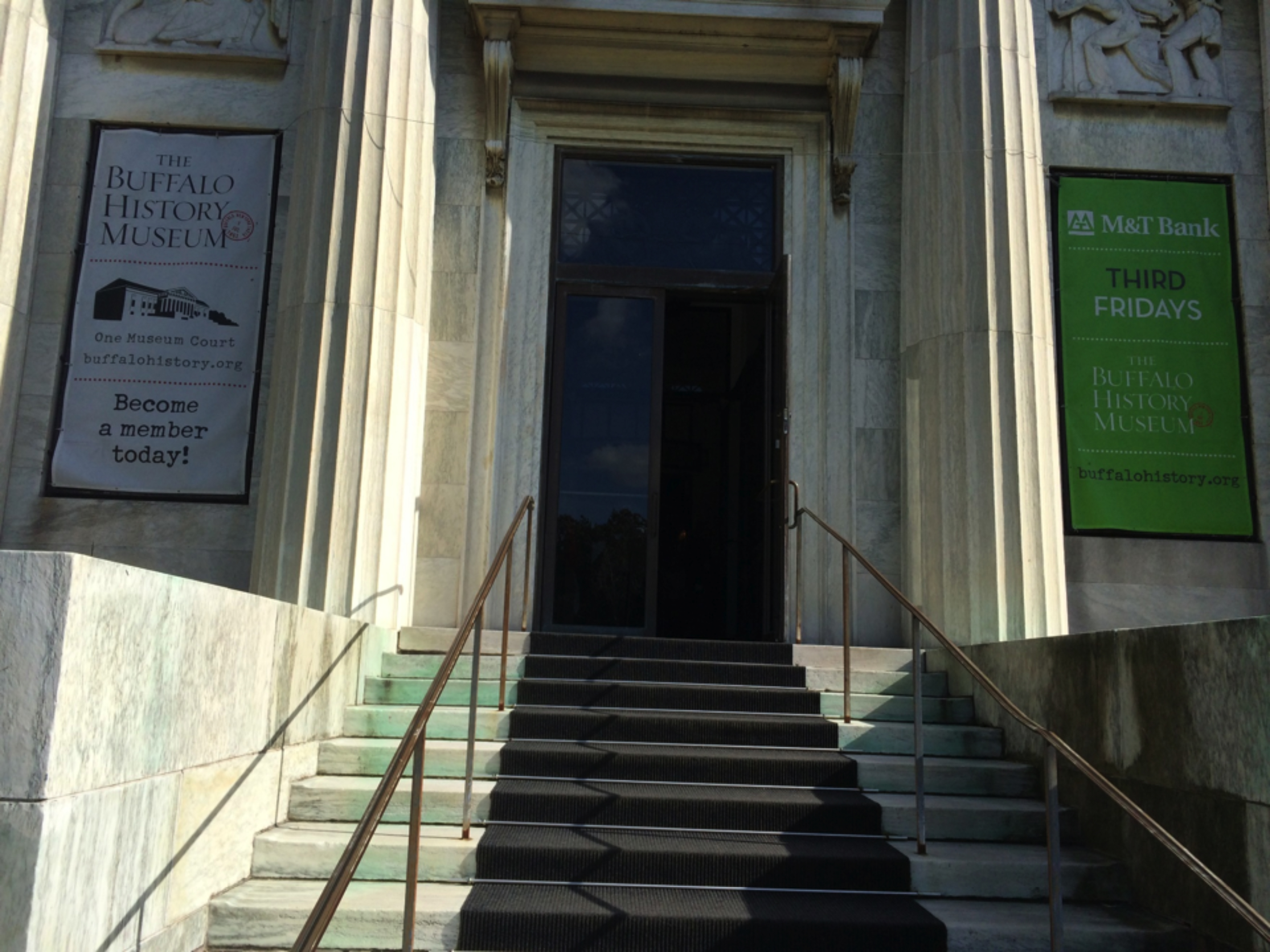
Figure 1 & 2: Welcome to The Buffalo History Museum, the home to the Howard D. Beach photography studio collection of glass negative plates.

beach2

Figure 3: Here is where the collection is currently being housed. Our class consists of 13 Graduate students, who are unearthing images that have yet to be viewed by anyone in almost 100 years. We are the first class to have our hands in this collection under the guidance of our professor Noelle Wiedemer. It is truly an exciting time!

The collection was found in the basement of the Howard D. Beach home and photographic studio when it was sold. Negatives, Paintings, Prints, Records, and Receipts were found in various states. From pristine condition to varying degrees of decay.beach3

Figure 5: These boxes represent a small smattering of the “other” items found among his collection besides the glass negatives. Some of the materials have been destroyed by time and weather, while other items are in almost pristine condition.

beach4 Figure 6: A yellowed image, clearly a very old print. Just one of many treasures waiting for their history to be revealed.

Figure 7: Some images, apparently frobeach5m first glance the images seem to be charcoal or pastel on paper, approximately, 16” X 20”. At this point, there are more questions than answers.
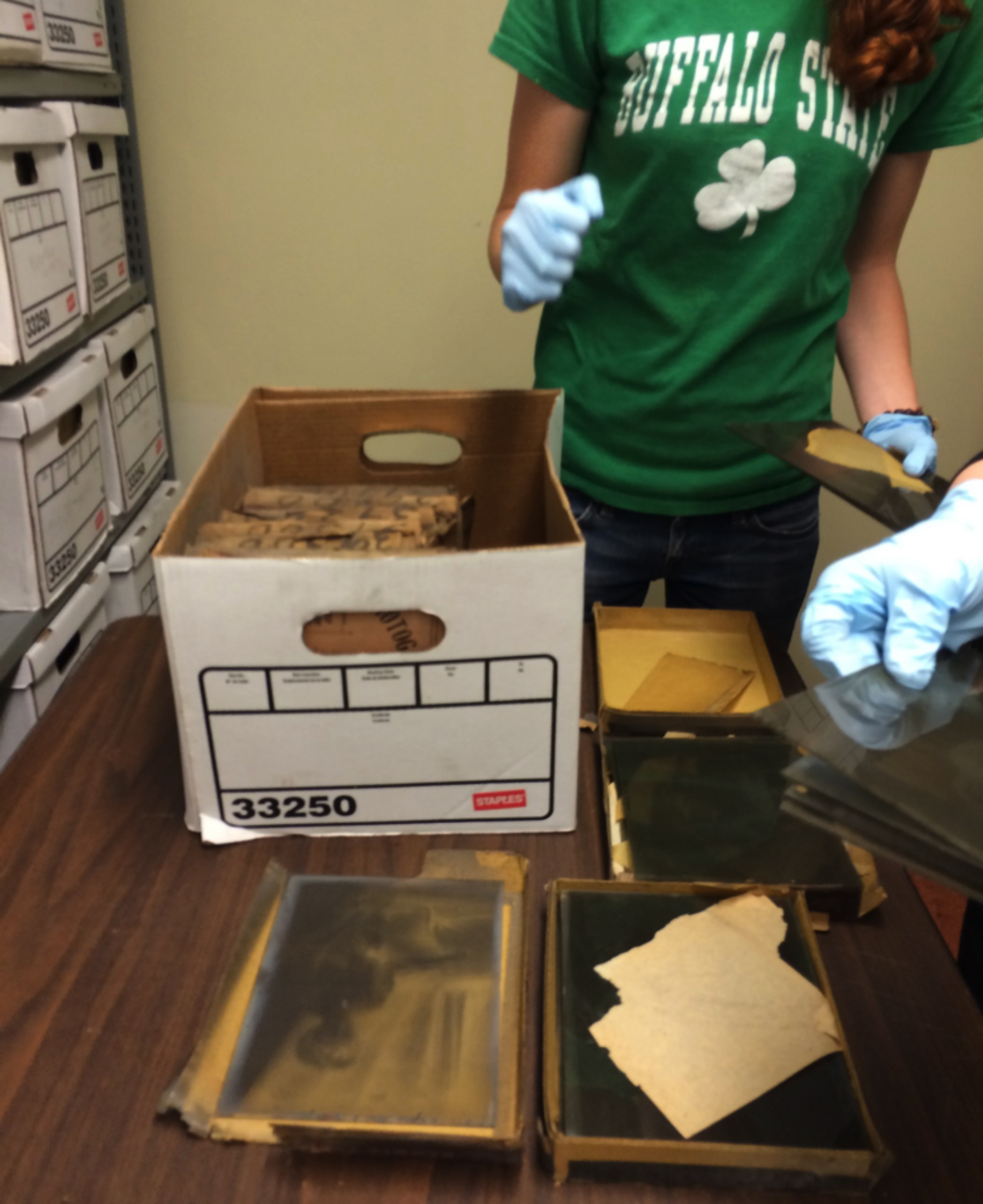
What are these? What were they used for? Did he use them somehow as back grounds that he super imposed in his photographs? Only time and looking further will tell.

beach6Figure 8: Walking into one of the rooms that store the Beach colbeach7lection, classmates are looking through a box of 6 ½” X 8” glass negatives box and showed me this; Figure 9: Excited to see H.D.B. (Howard D. Beach) showing women utilizing books in his photographs has set my mind in motion. I can’t help but wonder what year this photograph was taken nor what else might be uncovered with each box that is opened. It is hard to imagine 60,000 glass negatives. To help give the reader perspective, consider that each box in the background of Figure 9, contains 6-8 boxes containing approximately 12-16 negatives each.

beach8Figure 10: Today I opened the bankers box marked 42400-42700. As I had randomly selected a box of the 8” X 10” negatives, I had no idea what I would find inside! My mind raced about the possibilities of the hidden treasures that lay within; Gloves applied, equipped with pen, paper, camera and a light box, I gingerly pulled the first box of negatives out and laid them on the table. The box is numbered, it is unclear at this time, what it belongs to, however, I must be patient, as there are many steps to uncover the history of these negatives

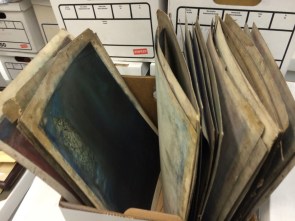
Figure 11: Looking in the Banker’s Box marked 42400-42700, rbeach9eveals five Hammer 8“ X 10” Photographic Dry Plate negative boxes in varying degrees of decay. Forgetting for a while to write any observations down at all, engrossed in the details of the glass, fascinated by the images of countless faces that have no significance to me, and yet, the negatives state with dignity that they lived. I find myself drawn to the details that accompanied each image and in Beach’s own handwriting, the name of the subject(s), delivery due date, Reference number(s) that correlated to the customer’s details stored in a meticulously kept card catalog.

beach10Figure 12: Manufacturer Hammer Dry Plate Company, Negative Box top. The image reveals the number 42400, which correlates to the numbers of the negatives found inside, or did presumably sometime in the past.

Figure 13: The above image is marked as the N Literary Society. The negative is shown with the emulsion side up, with the name of the customer, date (print was due for delivery to customer and a corresponding number that relates to the card catalog of Howard D. beach12Beach’s customers.

Figure 15: My curiosity continues to be peeked when I found this image of an older woman with her reading glasses holding a book open seemingly to a specific page. I can’t help but wonder if I will be able to read the poem when the negative is digitally inverted.

After several hours of looking through the five boxes I came away with a few images that struck a chord. I still have more images to select before I begin my research on the individuals of the images I have selected to research.

– Danielle Delia
Museum Studies student at Buffalo State

I Found a Newspaper in My Wall

newspaper_texture2814Every few months, the Library gets a call from a homeowner who is in the middle of a remodeling project. It usually goes like this: “I was tearing out my kitchen/bathroom/den and I found a page/section of Courier-Express/Buffalo Evening News from [date] in the wall/floor/ceiling. Does it have any value? Would you like to have it?”

The newspaper-in-the-wall discovery is surprisingly common. Perhaps it fell in through an opening the attic, a possibility in balloon-framed houses. Perhaps someone working on that wall left it there on purpose. Sometimes I wonder if there was a folk practice among tradesmen to leave a dated artifact behind to show when they had been there. But this is sheer speculation.

From the dates supplied by our callers, it seems that the newspaper-in-the-wall was most prevalent between the World Wars. A simple Google search on found a newspaper in the wall turned up stories from around the country of papers dated from the 1920s to the 1940s found during home remodeling projects.

So, let’s answer the top two questions from homeowners:

Does it have any value?
Probably only sentimental. IRS regulations prohibit museum employees from appraising (determining the market value) of private property. We suggest searching eBay to get a rough idea of values. For example, President Kennedy assassination newspapers in mint condition are listed on eBay from $5 to $100. In the end, an object is worth only what someone is willing to pay for it. Which leads to the second question:

newspaper_texture2821Would you like to have it?
Thanks, but no. Newspapers stored in walls are rarely in good condition. They are likely to be incomplete, torn, brittle, discolored, moldy, mildewed, possibly even infested with insects. We cannot risk exposing museum collections or visitors to these hazards. You have our blessing to display, sell, or discard your newspaper-in-the-wall as you see fit.

Don’t get me wrong: libraries have been collecting newspapers pretty much since the invention of newspapers. We pro-actively purchase them on microfilm. It is stable, compact, sturdy, tamper-proof, and resistant to mold, mildew, and insects. No one can deface a page or tear a picture out of film.

Here at the Buffalo History Museum, we have over 200 years of Buffalo newspapers on about 6,500 rolls of microfilm. Our microfilm reader-printer machines make copies from the film for $.25/each. Plus, like most libraries, we lend our newspaper films via interlibrary loan to out-of-town researchers. Readers who wish to borrow film need to make arrangements with your local library, who will handle the request on your behalf. There may be nominal fees.

Have you found a newspaper in your wall? If so, please send us pictures and stories to add to this page! And if there are homeowners or tradespeople out there who ever stuffed a newspaper in the wall during a remodeling or construction project, please tell us about it.

Cynthia Van Ness
DIRECTOR OF LIBRARY & ARCHIVES

Summer Intern Diaries

When I came to The Buffalo History Museum for an internship with the Collections department in the Resource Center, one of my primary tasks consisted of cataloguing a collection of Fisher-Price toys from the 1960s through the 1990s.

The collection is a treasure trove of Fisher-Price at its best: Little People and lap desks, chime balls and a cash register, telescopes and a Toot-Toot steam engine. ???????????????????????????????There’s a rainbow grand piano, a saxophone, and a xylo-drum. The oldest toy is a 1963 “Huffy Puffy Steam Engine” with a cheerful face on the engine and a caboose; the newest toy is the brightly colored saxophone, which chirps peppy notes and dispenses soap bubbles from its bell when played.

Aside from getting to revel in the nostalgia that accompanied cataloguing toys from my childhood, I was also lucky enough to interview one of Fisher-Price’s retired toy engineers. Fred Robjent worked as a Product Development Engineer from 1978 to 2005. After receiving his Associate’s degree in mechanical engineering and his Bachelor’s degree in agricultural mechanization, Mr. Robjent worked at a few smaller companies before joining the Fisher-Price team. Once hired, he went through a rigorous training program. He went on to work as an engineer for the company through its periods of massive growth, its time under Quaker Oats, and finally its purchase by Mattel.

Mr. Robjent helps Walter Mayer, our Director of Collections, with the upkeep and repair of an apostolic clock in the collection. When he heard we were doing a project on Fisher-Price artifacts, he brought a number of his own personal artifacts, vintage catalogs, and limited employee edition books to the Resource Center for me to use in my research. He was happy to shed light on the design process and share his knowledge of the specific artifacts in our collection.

Fisher Price Roller SkatesMr. Robjent personally worked on the iconic Fisher-Price roller skates. He designed and patented a mechanism that made the toy skates safer for preschoolers. If you had a pair of the skates in the early ‘90s, like I did, you might remember the yellow switch on the bottom of the skate that allowed parents to choose from three settings. One stopped the wheels from moving at all, one stopped the skates from rolling backwards, and one allowed uninhibited skating. While Mr. Robjent has eight patents in his name, this was the one that seemed to make him most proud.

Fred Robjent spoke often of the company’s desire to make the toys as safe as possible. Fisher-Price set numerous safety standards in the toy industry that remain in place today. However, when asked what he loved most about working for Fisher-Price, Mr. Robjent said that it was the company’s family atmosphere he loved most.

Samantha Vandermeade
Summer Intern, Collections Department